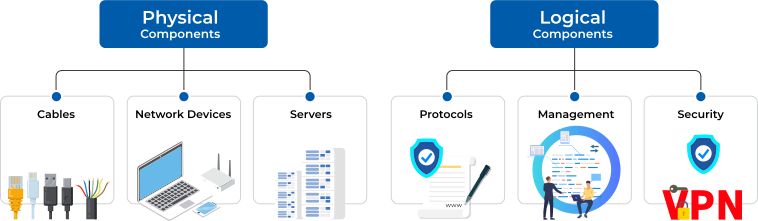
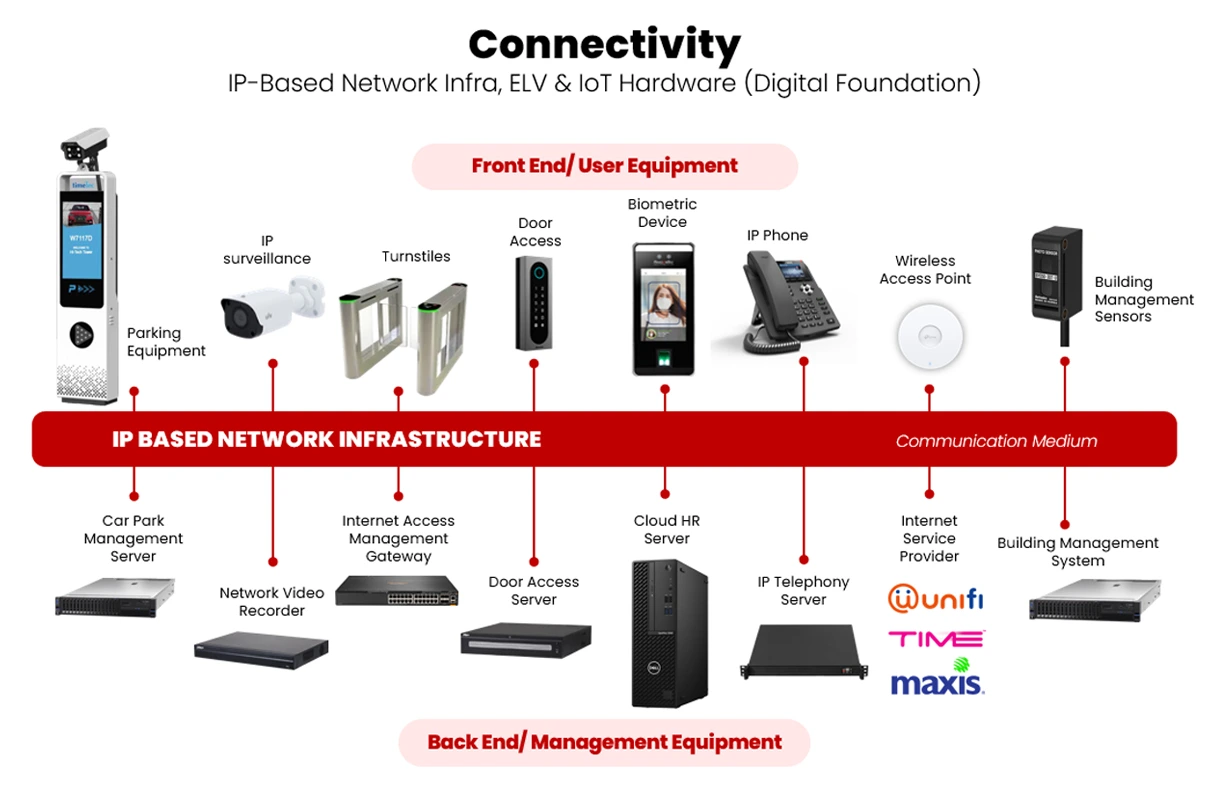
TimeTec offers complete Network Infrastructure solutions alongside our comprehensive PropTech ecosystem, delivering seamless connectivity to support smart building operations. From structured cabling to high-performance network equipment, our infrastructure services are designed to integrate flawlessly with TimeTec’s PropTech solutions—including smart access and elevator control, ELV & IoT automation, smart cashless and touchless parking, visitor management and etc., ensuring a reliable, scalable, and future-ready environment for modern commercial and residential buildings.
What Is a Well-Designed Network Infrastructure?
A well-designed network infrastructure is essential for any organization that relies on technology to operate effectively. It provides the foundation for integrating emerging technologies and new applications, allowing businesses to remain agile, up-to-date, and competitive in their industries.
For service providers, building a robust network infrastructure means ensuring scalability, high availability, and intelligent load balancing. These elements are critical to maintaining seamless connectivity and reliable system performance—key factors in today’s fast-paced digital environment.
Since network interruptions can never be entirely avoided, it's also vital to adopt streamlined network architectures and automated management tools. These help network administrators quickly identify, isolate, and resolve issues, minimizing downtime and ensuring optimal network functionality.
Uncontrolled stopping by immediate removal of power (e.g., cutting power to actuators).
It is essential to distinguish EN 60204-1 from other standards. It is specifically designed for machinery and is not to be confused with BS 7671 (the IET Wiring Regulations) for building electrical installations or the EN 61439 series for low-voltage switchgear and controlgear assemblies. Each standard has a distinct scope and application.
Verification of the continuity of the protective bonding circuit. Fault loop impedance verification. Insulation resistance tests (typically 500V DC testing). Voltage tests (withstanding test). Functional tests to ensure control systems operate safely. Why You Need the Official EN 60204-1 PDF
Guarantee compliance with EU Directives for legal market entry. Core Technical Requirements of EN 60204-1
Machines must feature a clear means to isolate the electrical equipment from the power supply.
Categorizing stop functions (Category 0, 1, or 2) and requiring that an E-stop override all other functions. 5. Operator Interface and Control Devices
Separate power cables from sensitive signal cables to prevent electromagnetic interference (EMI). 5. Testing and Verification
All structural metal parts must be connected to a protective bonding circuit to ensure automatic disconnection of power during a insulation fault. 2. Incoming Supply Disconnection
Control configurations must prevent safety devices (like light curtains or interlocks) from being inadvertently bypassed during standard operations. 4. Emergency Stop Functions
The EN 60204-1 standard is the cornerstone of electrical safety for machinery in the European Union. Compliance with this standard is mandatory for manufacturers aiming to apply the CE mark and legally sell machines within the European Economic Area. Finding an official "EN 60204-1 PDF" is the first step for engineers designing control panels and electrical systems for industrial machinery. What is EN 60204-1?
En 602041 Pdf !!hot!! Access
Uncontrolled stopping by immediate removal of power (e.g., cutting power to actuators).
It is essential to distinguish EN 60204-1 from other standards. It is specifically designed for machinery and is not to be confused with BS 7671 (the IET Wiring Regulations) for building electrical installations or the EN 61439 series for low-voltage switchgear and controlgear assemblies. Each standard has a distinct scope and application.
Verification of the continuity of the protective bonding circuit. Fault loop impedance verification. Insulation resistance tests (typically 500V DC testing). Voltage tests (withstanding test). Functional tests to ensure control systems operate safely. Why You Need the Official EN 60204-1 PDF en 602041 pdf
Guarantee compliance with EU Directives for legal market entry. Core Technical Requirements of EN 60204-1
Machines must feature a clear means to isolate the electrical equipment from the power supply. Uncontrolled stopping by immediate removal of power (e
Categorizing stop functions (Category 0, 1, or 2) and requiring that an E-stop override all other functions. 5. Operator Interface and Control Devices
Separate power cables from sensitive signal cables to prevent electromagnetic interference (EMI). 5. Testing and Verification Each standard has a distinct scope and application
All structural metal parts must be connected to a protective bonding circuit to ensure automatic disconnection of power during a insulation fault. 2. Incoming Supply Disconnection
Control configurations must prevent safety devices (like light curtains or interlocks) from being inadvertently bypassed during standard operations. 4. Emergency Stop Functions
The EN 60204-1 standard is the cornerstone of electrical safety for machinery in the European Union. Compliance with this standard is mandatory for manufacturers aiming to apply the CE mark and legally sell machines within the European Economic Area. Finding an official "EN 60204-1 PDF" is the first step for engineers designing control panels and electrical systems for industrial machinery. What is EN 60204-1?