Culture & Society Topics

"Should Schools Have Grade Requirements for Student Athletes?"
View a sample activityStill, there is an argument to be made for looking back there. The boy at the back often holds the room’s counterpoint — the unspoken commentary, the alternative melody, the patience that waits for a fuller harmony. If you sit beside him, you will find a companion who notices what you forget to see and who can make the ordinary sing in a different key.
If done correctly, the credits roll over a live-action video of a real abandoned school in Japan, with a single backpack hanging on a hook. It is devastating.
'Fantasia' version 2.3.3 by The Kid At The Back stands as a testament to the enduring power of music to capture the human experience in all its complexity. Through Lenker's masterful storytelling and the project's innovative blend of indie folk and chamber music, listeners are offered a work of art that is both a reflection of our shared humanity and a solace in times of need. As 'Fantasia' continues to resonate with audiences, it reaffirms The Kid At The Back's place as a significant voice in contemporary music, pushing the boundaries of emotional expression and musical innovation.
The most significant addition is the subtitle, which acts as a parallel game mode. When you start a new save file, you are asked: "Do you wish to hear the music of the forgotten?"
This update introduces a brand new "What-If" scenario separate from the main canon. In this surreal route, the protagonist and the eponymous "Kid" are trapped in a looping dreamscape of their ideal school life. However, the cracks in this "Fantasia" begin to show as the environment glitches, revealing the dark reality hidden underneath the pretense of perfection.
Why ? The developer (known only as Noise_Corpse ) posted a cryptic dev log three weeks before the update: "Version 2.3.2 was the nightmare. Version 2.3.3 is the daydream you have while trying to avoid the nightmare."
Optimization for high-resolution displays without losing pixel-art charm.
Despite these bugs, the Steam Deck verification holds up remarkably well. The game looks stunning on the OLED screen, especially the Fantasia mode’s use of high-contrast purple and gold hues.
Leo looked down. His desk was no longer wood; it was a carved slab of obsidian etched with his own childhood secrets. He realized then that he wasn't just a student in a classroom. He was the anchor for the entire simulation.
It features a romance point counter visible on the screen, where player choices directly impact the story and determine which character-specific illustrations (CGs) are unlocked.
Sociologists note that physical position in a room correlates with psychological distance. The Kid at the Back has optimized his firmware (v2.3.3) for peripheral vision. He sees the entire room: the teacher’s forced enthusiasm, the popular cohort’s subtle power plays, the frantic note-passing of the unprepared. From his vantage, the curriculum becomes a performance. He does not disrupt it; he annotates it. His fantasia begins where the lesson plan ends.
The version number— v2.3.3 —implies a history of updates. V1.0 might have been the dreamer, lost in clouds. V2.0 the sarcastic critic. But v2.3.3 has integrated patches for survival: the ability to look attentive while mentally composing symphonies, the skill of dodging a cold call with a vague, unassailable nod. It is the version that has learned that silence is a form of power. In a world obsessed with extroverted metrics (class participation grades, group projects), the Kid at the Back has debugged the need for external validation.
is not a product. It is a weather system for the soul. In an era of battle passes and dopamine loops, this game demands that you sit in a plastic chair and listen to the rain turn into a symphony.
Previously, the classroom operated on a rigid 15-minute loop. At 2:50 PM, the intercom would glitch. At 2:55 PM, the rain would start. In -v2.3.3- , the schedule is gone. Instead, a new UI element appears: a metronome on the teacher’s desk that swings between Adagio (slow, heavy dread) and Presto (frenetic, colorful static).
Still, there is an argument to be made for looking back there. The boy at the back often holds the room’s counterpoint — the unspoken commentary, the alternative melody, the patience that waits for a fuller harmony. If you sit beside him, you will find a companion who notices what you forget to see and who can make the ordinary sing in a different key.
If done correctly, the credits roll over a live-action video of a real abandoned school in Japan, with a single backpack hanging on a hook. It is devastating.
'Fantasia' version 2.3.3 by The Kid At The Back stands as a testament to the enduring power of music to capture the human experience in all its complexity. Through Lenker's masterful storytelling and the project's innovative blend of indie folk and chamber music, listeners are offered a work of art that is both a reflection of our shared humanity and a solace in times of need. As 'Fantasia' continues to resonate with audiences, it reaffirms The Kid At The Back's place as a significant voice in contemporary music, pushing the boundaries of emotional expression and musical innovation.
The most significant addition is the subtitle, which acts as a parallel game mode. When you start a new save file, you are asked: "Do you wish to hear the music of the forgotten?" The Kid At The Back -v2.3.3- -fantasia-
This update introduces a brand new "What-If" scenario separate from the main canon. In this surreal route, the protagonist and the eponymous "Kid" are trapped in a looping dreamscape of their ideal school life. However, the cracks in this "Fantasia" begin to show as the environment glitches, revealing the dark reality hidden underneath the pretense of perfection.
Why ? The developer (known only as Noise_Corpse ) posted a cryptic dev log three weeks before the update: "Version 2.3.2 was the nightmare. Version 2.3.3 is the daydream you have while trying to avoid the nightmare."
Optimization for high-resolution displays without losing pixel-art charm. Still, there is an argument to be made
Despite these bugs, the Steam Deck verification holds up remarkably well. The game looks stunning on the OLED screen, especially the Fantasia mode’s use of high-contrast purple and gold hues.
Leo looked down. His desk was no longer wood; it was a carved slab of obsidian etched with his own childhood secrets. He realized then that he wasn't just a student in a classroom. He was the anchor for the entire simulation.
It features a romance point counter visible on the screen, where player choices directly impact the story and determine which character-specific illustrations (CGs) are unlocked. If done correctly, the credits roll over a
Sociologists note that physical position in a room correlates with psychological distance. The Kid at the Back has optimized his firmware (v2.3.3) for peripheral vision. He sees the entire room: the teacher’s forced enthusiasm, the popular cohort’s subtle power plays, the frantic note-passing of the unprepared. From his vantage, the curriculum becomes a performance. He does not disrupt it; he annotates it. His fantasia begins where the lesson plan ends.
The version number— v2.3.3 —implies a history of updates. V1.0 might have been the dreamer, lost in clouds. V2.0 the sarcastic critic. But v2.3.3 has integrated patches for survival: the ability to look attentive while mentally composing symphonies, the skill of dodging a cold call with a vague, unassailable nod. It is the version that has learned that silence is a form of power. In a world obsessed with extroverted metrics (class participation grades, group projects), the Kid at the Back has debugged the need for external validation.
is not a product. It is a weather system for the soul. In an era of battle passes and dopamine loops, this game demands that you sit in a plastic chair and listen to the rain turn into a symphony.
Previously, the classroom operated on a rigid 15-minute loop. At 2:50 PM, the intercom would glitch. At 2:55 PM, the rain would start. In -v2.3.3- , the schedule is gone. Instead, a new UI element appears: a metronome on the teacher’s desk that swings between Adagio (slow, heavy dread) and Presto (frenetic, colorful static).
Culture & Society Topics
"Should Schools Have Grade Requirements for Student Athletes?"
View a sample activity Quill Connect
Help your students advance from fragmented and run-on sentences to complex and well-structured ones.
Using the evidence-based strategy of sentence combining, students combine multiple ideas into a single sentence. They then receive instant feedback designed to help them improve their clarity and precision.
 Quill Lessons
The Quill Lessons tool enables teachers to lead whole-class and small-group writing instruction.
Teachers control interactive slides that contain writing prompts, and the entire class responds to each prompt. Each Quill Lessons activity provides a lesson plan, writing prompts, discussion topics, and a follow up independent practice activity.
 Quill Diagnostic
Quickly determine which skills your students need to work on with our diagnostics.
The diagnostics cover vital sentence construction skills and generate personalized learning plans based on the student’s performance.

Spanish

Mandarin

French

Vietnamese

Arabic

Hindi

Russian

Ukrainian

Urdu

German

Tagalog

Portuguese

Thai

Dari

Japanese

Korean
 Quill Proofreader
Proofreader teaches your students editing skills by having them proofread passages.
Students edit passages and receive personalized exercises based on their results. With more than 150 expository passages, Proofreader gives students the practice they need to spot common grammatical errors.
 Quill Grammar
Students practice basic grammar skills, from comma placement to parallel structure.
Quill Grammar has more than 250 sentence writing activities to help your students. Our activities are designed to be completed in 10 minutes so you have the freedom to use them in the way that works best for your classroom.


You can quickly and easily set up your classroom in Quill by inputting student names or providing students with a unique code. If you use Google Classroom or Clever, you can automatically set up your classroom with one click.

Decide if you want your students to proofread passages, combine sentences, or complete a diagnostic. Use our ten minute activities as building blocks during your classroom instruction.

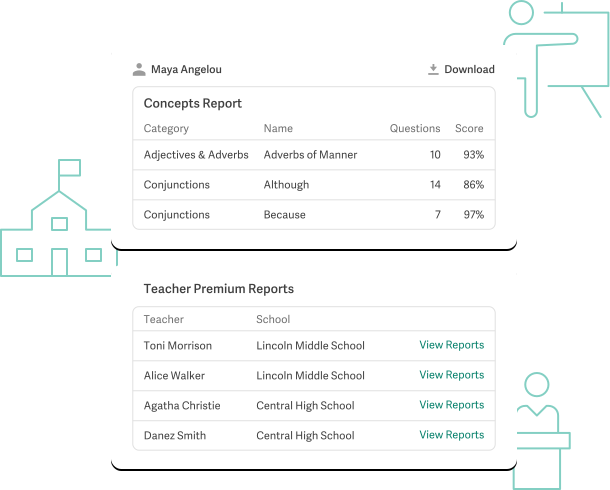
Use our reporting to spot trends and identify growth opportunities. Monitor comprehension on specific writing standards.

Get immediate feedback for your students
Save time grading and watch your students correct their mistakes instantly.

Intervene where students struggle
See exactly where your students need intervention with our comprehensive reports.

Differentiate learning to meet the
needs of all students
Assign specific activities for ELLs and students with learning differences.

Engage students with adaptive activities
Challenge students with questions that automatically adapt based on their previous responses.

Align with the Common Core Standards
Easily meet Common Core language standards with our aligned activities.

Easily sign up with Google Classroom
With one click, all of your students and classes will be imported.
Over 100 concepts totaling 50 hours of quality curriculum.
Join over 44,000 schools using Quill to advance student writing.





Quill Premium
Quill Premium's advanced reporting features are the best way to support teachers at the school or district level.